
Introduction: Off-the-Shelf Software Will Never Solve Your Specific Problem
Your company isn't a generic company. You have your processes, your habits, your data flows, your industry specificities. Yet, like most SMEs, you probably use software designed for everyone — and which, as a result, fits no one perfectly.
The result: endless Excel exports to fill gaps, information copied from one tool to another, business processes that live on Post-its and in your colleagues' heads. And hours each week absorbed by tasks that could be automated.
French SMEs lose an average of 6 hours per week per employee due to inefficient processes. Over a year, for a team of 10 people, that's 3,000 hours evaporated in tasks without added value.
A custom business application isn't a project for large groups. It's the tool that allows Le Mans and Sarthe SMEs to gain efficiency, reactivity and competitiveness — without fighting against software that wasn't designed for their reality.
What is a Custom Business Application?
A business application (or "custom back-office" or "internal tool") is software developed specifically to meet the needs of a given company. Unlike commercial software like Salesforce, Sage or Monday, it's designed around your processes — not the other way around.
Concrete examples in the Sarthe context:
- A mechanical parts manufacturer in Le Mans managing their production orders, supplier deadlines and stocks in a homemade tool connected to their machine tool
- A Sarthe construction company piloting their sites, field teams and delivery notes from a mobile app without paper
- An HR services firm in La Flèche automating client onboarding, administrative document generation and mandatory training tracking
- A local commerce network in Le Mans synchronizing stocks, promotions and customer data between its 4 points of sale
- A home services provider in Sarthe planning interventions, collecting intervention signatures, and generating time sheets automatically
In each of these cases, a standard software existed on the market — but none fit exactly the needs. The custom application filled these gaps and produced immediately measurable time and reliability gains.
Why Now? The 2026 Context Changes the Equation
Five years ago, developing a custom business application was reserved for companies that had €50,000 to invest and 18 months ahead of them. Technologies, development tools and practices have evolved.
In 2026, the cost and time of custom development have been divided by 3 to 5 compared to 2020, thanks to modern frameworks and AI-assisted development tools. A project that would have taken 12 months now takes 3 or 4. A project that cost €80,000 can now be conceived for €15,000 to €25,000.
This change democratizes access to custom tools for SMEs — including those in Le Mans and Sarthe who didn't have the resources to access them before.
Furthermore, regional and national competition is equipping itself. Companies that still rely on manual processes or Excel workarounds are gradually losing ground against competitors who have automated.
The 5 Situations That Signal a Business Application Would Help You
1. You Have Excel Files That Know More Than Your Team
If your operational management relies on shared Excel files, with fragile macros and formulas that only Jean-Marc understands — you have a scalability and reliability problem.
An Excel file doesn't handle simultaneous access, doesn't guarantee data integrity, doesn't send automatic alerts, and doesn't integrate with your other tools. And when Jean-Marc retires, he leaves with half your information system.
2. You Re-enter the Same Information in Multiple Places
Your quote is in your CRM. The order is recopied into your ERP. The invoice is manually generated in your accounting software. And delivery information is entered again in your transport software.
Each re-entry is lost time and an opportunity for error. An application that connects these flows eliminates these frictions and dramatically reduces errors.
3. Your Field Teams Still Work with Paper
Delivery notes, intervention sheets, quality control forms, attendance records... In many Sarthe sectors (construction, logistics, home services, industrial maintenance), paper still reigns.
A custom mobile app can replace all this paper: input on tablet or smartphone, electronic signature, automatic sending to the office, instant archiving. Time and reliability gains are often in the range of 30 to 50%.
4. You Can't Have a Real-Time View of Your Activity
Where are your current orders? Which sites are late? Which salesperson is at what level toward their monthly goal? How many hours has your team worked this week?
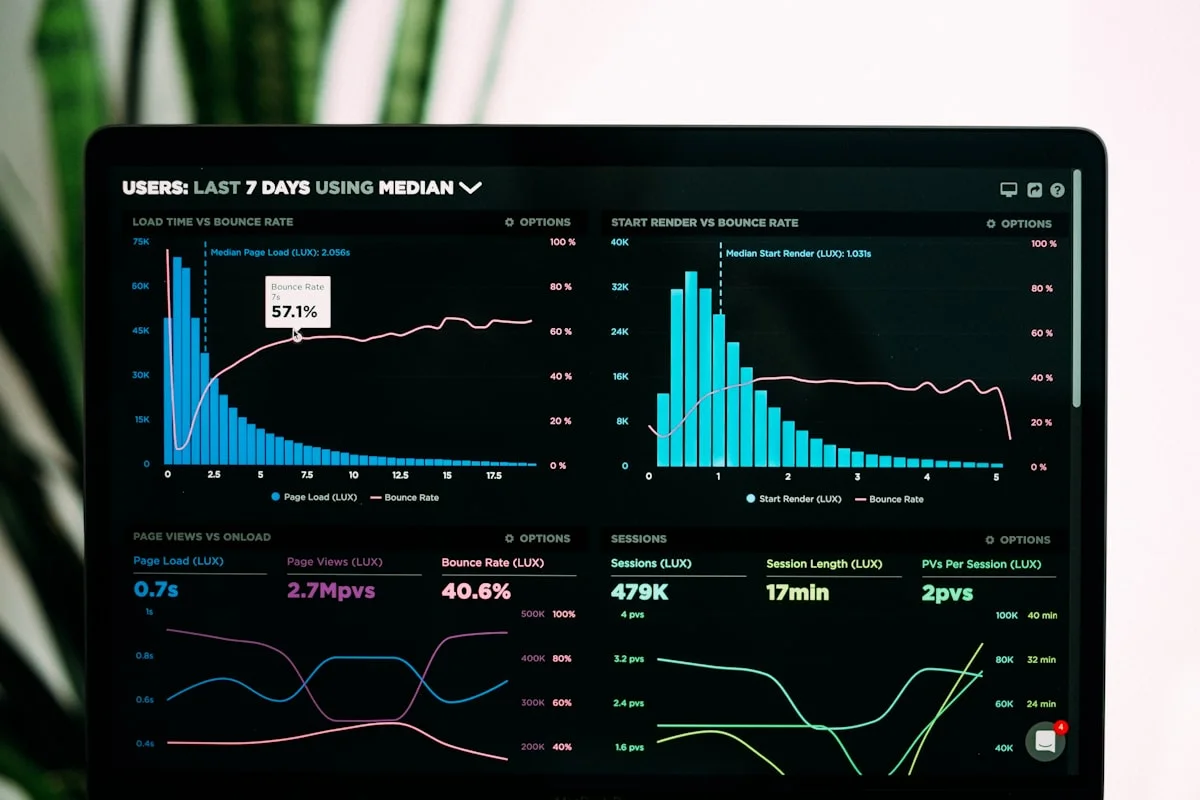
If these questions require manually compiling data before answering them, you're flying blind. A dashboard connected to your business application answers all these questions in real-time — from your phone.
5. Your Off-the-Shelf Software Costs More Than It Returns
You pay monthly licenses for software that your team only uses at 20% capacity, some modules don't match your activity, and require regular training because the interface changes with each update.
Over 5 years, custom application is often cheaper than accumulating SaaS licenses — and it's entirely adapted to what you need.
The ROI of a Business Application: How to Calculate It
The return on investment of a business application is measured on several axes:
Direct time savings. If your application saves 2 hours per day for 3 employees (6 hours), at a loaded salary cost of €30/h, that's €180/day saved — or €45,000/year. An investment of €20,000 is amortized in less than 6 months.
Error reduction. A billing error, a lost delivery note, a poorly entered order: in B2B, errors have direct costs (credits, disputes, delays) and indirect costs (degraded customer relationship). A well-designed application structurally reduces these errors.
Commercial advantage. Responding faster, delivering faster, informing your customer in real-time about the status of their order or site: that's concrete differentiation. In a Sarthe context where many SMEs still operate traditionally, this advantage is real and visible.
Scalability. With manual processes, doubling business volume means doubling staff. With automated processes, you can absorb significant growth without proportional hiring.
How We Build a Business Application at nexIT
Our approach for Le Mans and Sarthe companies is progressive and risk-free:
Phase 1 — Scoping (2 to 4 weeks) We spend time with you and your teams to understand your current processes, map frictions, identify key data and define the tool's scope. We don't code yet — we listen and structure.
At the end of this phase, you have a clear specification and precise pricing. You can decide to continue or not, without pressure.
Phase 2 — The MVP (4 to 8 weeks) We develop the minimum functional version of your application — the 20% of features that cover 80% of your need. You use it in real conditions with your team. We collect feedback.
Phase 3 — Iterations We refine, complete, integrate with your existing tools. The application evolves with your real usage, not with what we imagined upfront.
Phase 4 — Ongoing Support We stay with you for evolutions, bugs, new features. Your application isn't a delivered and forgotten project — it's a living tool.
Examples of What We Can Build for Sarthe Sectors
Industry and manufacturing: production management, manufacturing order tracking, material traceability, digital quality control, preventive maintenance
Construction and craftsmen: site management, team planning, dematerialized intervention notes, hours tracking, quotes and invoices
Commerce and distribution: multi-site stock management, cash/back-office synchronization, loyalty program, customer portal
Business services: custom CRM, project tracking, employee portal, administrative automation
Personal services: intervention planning, service tracking, time sheets, family/provider communication
Conclusion: Business Application, the Most Underestimated Competitive Lever for SMEs
In Sarthe, companies that have invested in custom internal tools have a discrete but lasting competitive advantage. They deliver faster, make fewer errors, have better visibility on their activity, and can grow without degrading their service quality.
✅ Automated processes that free time for what truly has value ✅ Reliable data accessible in real-time by the whole team ✅ Visible customer advantage: reactivity, transparency, quality ✅ Measurable ROI often achieved in 6 to 18 months ✅ A tool that's yours and evolves with your company
Business application is no longer a luxury reserved for large groups. It's the lever that ambitious Le Mans and Sarthe SMEs can activate now to get ahead.
Your Process Deserves Better Than Excel
At nexIT, we support Sarthe SMEs in designing and developing custom internal tools. We always start by understanding your reality before proposing a solution — because your problem is unique, and your tool must be too.
A 45-minute discussion is often enough to identify whether a business application would help you and, if so, where to start.
nexIT — Business application development for Le Mans and Sarthe companies.
Discover our custom software servicesRequest a feasibility study